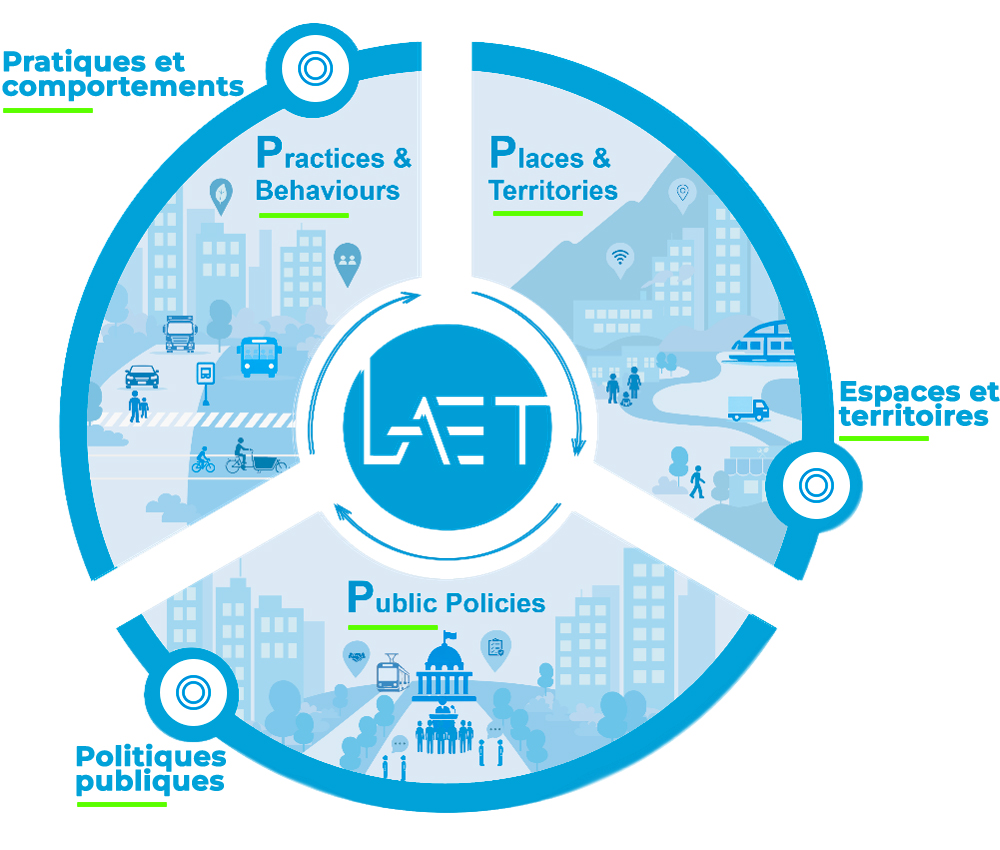

Research at LAET is organised into three complementary interdisciplinary research groups, which examine passenger and freight transport and mobility from different perspectives and scales of analysis. The first focuses on mobility practices and behaviour, the choices and constraints that shape them, and the inequalities associated with them. The second explores the interactions between mobility and the spatial organisation of territories, particularly in relation to location, accessibility and resilience. The third examines how mobility is addressed through public policy, focusing on the development, evaluation and regulation of transport and mobility policies. This structure brings together the laboratory’s research topics, methods and disciplinary perspectives, while examining the interactions between mobility practices, territorial dynamics and public policies.
The research groups organise their own thematic seminars, alongside seminars shared across all three groups. These foster scientific exchange through disciplinary approaches, particularly in transport economics and spatial planning, as well as interdisciplinary and cross-cutting perspectives, including a seminar dedicated to epistemological questions.
Practices and behavior: modal choice, innovations and inequalities

This research group focuses on freight transport choices as well as the mobility practices and behavior of individuals and houselholds. Research seeks to understand how habits, economic constraints, lifestyles and working patterns, along with social and territorial characteristics, shape these choices. It draws on a wide range of qualitative and quantitative methods, as well as mixed-methods approaches and modelling.
Research also examines changes in mobility practices, including the development of shared mobility, cycling, new vehicles and transport services, as well as the growth of digital platforms, remote working and e-commerce. These developments are reshaping how transport modes are used and changing travel needs.
Particular attention is paid to inequalities in access to mobility, related to factors such as income, age, gender, access to vehicles and mobility-related and digital skills. These issues are studied across a range of territorial contexts, from urban to rural areas, in countries of both the Global North and Global South.
Practices and behavior: modal choice, innovations and inequalities
RESEARCH GROUP
Spaces and territories: location patterns, emerging urban forms and resilience

This research group examines the interactions between transport, mobility and the spatial organisation of territories. It explores how accessibility and transport infrastructure influence the location choices of households and businesses, economic and residential dynamics, as well as the mobility needs of people and goods.
Research also addresses changes in urban forms, particularly those associated with the development of remote activities, digital services and new forms of logistics organisation. It examines the relationships between these developments and mobility, as well as opportunities for transitioning towards urban forms and transport systems that require fewer resources.
Territorial vulnerability and resilience are another major focus. Research examines spatial disparities, segregation and isolation, car dependency, and the capacity of territories and transport networks to cope with crises and disruptions.
Spaces and territories: location patterns, emerging urban forms and resilience
RESEARCH GROUP
Public policy: policymaking, evaluation and regulation under conditions of instability
This research group examines the development, evaluation and implementation of mobility policies in a context marked by changing practices, the emergence of new actors and increasingly frequent social, economic and environmental crises. A central concern is understanding how mobility problems are defined, debated and addressed by public authorities.
Research also investigates the instruments and methods used to develop public policies and evaluate their effects. It focuses on data, mobility models, evaluation methods and investment decisions, examining how these tools are used and their limitations in the face of changing mobility patterns and uncertainty.
Research further explores changes in the regulation of transport and mobility systems, including pricing, the introduction of competition, low-emission zones and the regulation of new services and operators. It examines how these policies are implemented and their social, economic and territorial effects.
Public policy: policymaking, evaluation and regulation under conditions of instability
Contents
Your cookies
By continuing your navigation or by clicking on "Accept all", you accept the deposit of third-party cookies intended to offer you videos, sharing buttons, content feedback from social platforms...
More information